
 it
it en
en +39 039 9911011
 +39 039 9910445
 info@ter.it


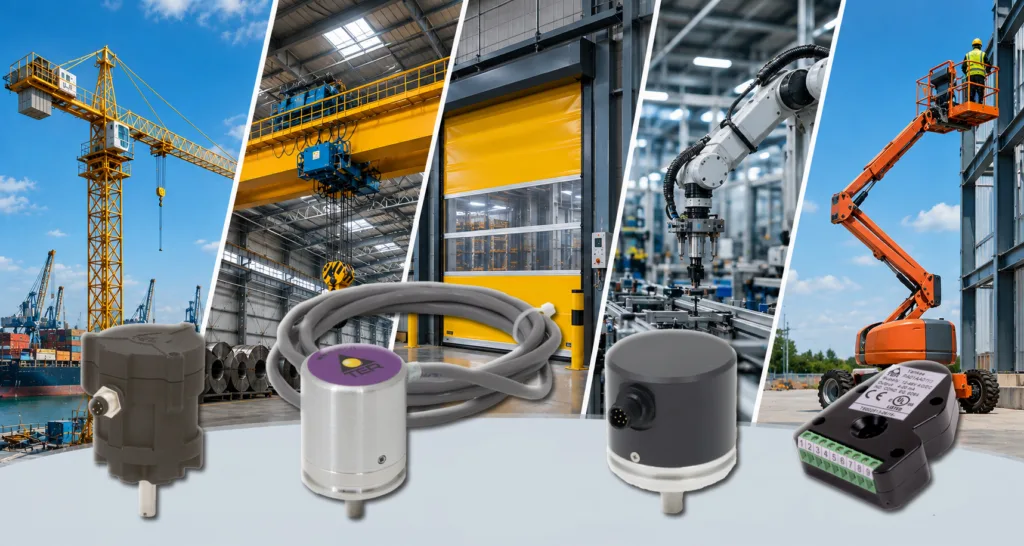
In automation systems designed for heavy-load handling, accurate position and speed feedback is a requirement that allows no compromise. An industrial encoder converts mechanical motion into a digital or analogue signal that can be interpreted by the control system, providing the PLC with the information required to safely manage acceleration, deceleration and precise positioning. TER develops encoder solutions for the harsh environments typical of industrial lifting, where vibration, temperature fluctuations and contaminants put sensor reliability to the test.
An industrial encoder for heavy machinery should be selected by assessing its resolution in pulses per revolution, whether it is incremental or absolute, its compatibility with the PLC communication protocol and the required degree of mechanical protection. Heavy-duty lifting applications require high IP ratings and resistance to continuous vibration.
The role of encoders in motion control
An encoder converts angular rotation into an electrical signal used by the control system to determine position, speed or direction. In heavy machinery such as tower cranes, overhead travelling cranes and winches, this information is essential for implementing safe, repeatable control logic and preventing overtravel or positioning errors that could compromise the structural integrity of the installation. A noisy or inaccurate signal causes unwanted fluctuations in motor operation, resulting in accelerated mechanical wear and a shorter service life for the transmission system.
Incremental vs absolute encoders
An incremental encoder generates a pulse train proportional to the rotation, providing relative position data that requires an initial reference point to be established through a homing procedure at start-up. It is a cost-effective solution for applications where loss of the position reference does not represent a critical risk.
An absolute encoder, by contrast, retains the exact angular position even when the power supply is disconnected and makes it immediately available when power is restored. It is the preferred choice for heavy-duty lifting applications, where restarting without losing the position reference reduces machine downtime and the risks associated with an unverified load position.
Resolution, protocols and PLC integration
Resolution, expressed in pulses per revolution or bits, determines the level of detail of the position data. For standard lifting applications, 1,000–5,000 pulses per revolution are generally sufficient, while applications requiring millimetre-level positioning—such as port cranes used for container handling—require higher resolutions or multiturn encoders.
TER encoders support advanced communication protocols such as CANopen and the SSI interface, ensuring integration with the main distributed control systems used in modern installations. The correct protocol should be selected according to the existing network architecture to avoid intermediate signal conversions that could introduce latency or additional points of failure.
Mechanical and Environmental Resistance in Harsh Environments
Encoders are exposed to continuous mechanical stress and high-frequency vibration. TER enclosures, made of die-cast aluminium or reinforced engineering polymers, provide protection ratings up to IP66 and IP67. In marine and port applications, where salt spray poses a constant corrosion risk, surface treatments and stainless-steel components are used.
The integration of encoders into TER rotary limit switches provides an additional level of redundancy by combining continuous position feedback with electromechanical stopping functions.
Certifications and Reference Standards
Compliance with the applicable electromagnetic compatibility requirements is essential to prevent interference generated by variable-frequency drives or power components. TER’s manufacturing processes comply with the UNI EN ISO 9001:2015 quality management system and the RoHS and REACH requirements, which are increasingly important to purchasing departments when selecting suppliers of electronic components for lifting applications.
Technical note: the standards quoted in the Italian text should be checked. EN 60204-1 concerns the electrical equipment of machines, while EN 60326-2-3 and EN 60326-3-1 may be incorrect references—possibly intended as standards from the EN 61326 series.
Frequently asked questions about industrial encoders
What is the difference between an incremental encoder and an absolute encoder?
The incremental encoder provides relative position data and requires a homing procedure after each restart, whereas the absolute encoder retains the exact position even when power is disconnected.
What resolution is Required for heavy duty lifting?
For standard lifting applications, a resolution of 1,000–5,000 pulses per revolution is generally sufficient. Applications requiring millimetre-level positioning, such as port cranes, require higher resolutions or multiturn encoders.
Which communication protocols do TER encoders support?
TER encoders support CANopen and the SSI interface and are compatible with the main distributed control systems.
How should an encoder be correctly installed on an industrial motor?
Correct installation requires accurate mechanical alignment of the encoder shaft with the axis of rotation, verification that the connectors are properly sealed in accordance with the declared IP rating, and a complete functional test before commissioning.
Technical section for experts
Procedure for functionally testing an encoder after installation
Check the mechanical alignment of the encoder shaft with the axis of rotation. Verify the power supply and ensure that the connectors are properly sealed in accordance with the declared IP rating. Perform a complete operating cycle, comparing the position detected by the PLC with the actual physical position. For incremental models, repeat the homing procedure before commissioning.
Conclusion
Choosing the right industrial encoder ensures long-term accuracy, safety and operational continuity. Developed for the harsh operating environments typical of lifting applications, TER solutions provide technical departments with reliable position feedback under all operating conditions.