
 it
it en
en +39 039 9911011
 +39 039 9910445
 info@ter.it


In the field of advanced industrial automation and heavy-duty lifting applications, safety reaches its highest level of importance when machinery operates in potentially explosive atmospheres.
Industries such as Oil & Gas, grain handling and storage, chemical processing and port logistics require electromechanical components specifically designed to eliminate any potential source of ignition. In these applications, Human-Machine Interface (HMI) devices and limit switches must comply with stringent international safety requirements.
ATEX-certified limit switches and pendant control stations represent the only engineering solution capable of combining operational continuity with the highest level of protection for both personnel and equipment.
ATEX limit switches and industrial control stations for hazardous areas are electromechanical devices designed with flameproof enclosures specifically engineered to contain any internal ignition and prevent its propagation to the surrounding explosive atmosphere. Selecting these components requires a careful assessment of the hazardous area classification (Zone 1 and Zone 2 for gas; Zone 21 and Zone 22 for combustible dust), verification of the required IP protection degree, and compliance with the applicable European safety directives.
The Origin of the Hazard: explosive atmospheres and area classification
An explosion occurs when a fuel (gas, vapour or combustible dust) mixes with oxygen within its flammability limits and encounters an energy source capable of causing ignition. In industrial automation, the switching of conventional electrical contacts inherently generates micro-arcs.
To eliminate this source of risk, the ATEX Directive 2014/34/EU establishes a strict classification of hazardous areas according to the probability and duration of the presence of an explosive atmosphere:
- Zone 1 and Zone 21: Areas where an explosive atmosphere consisting of gas or vapour (Zone 1) or combustible dust (Zone 21) is likely to occur occasionally during normal operation.
- Zone 2 and Zone 22: Areas where an explosive atmosphere consisting of gas (Zone 2) or combustible dust (Zone 22) is not likely to occur during normal operation or, if it does occur, will persist only for a short period.
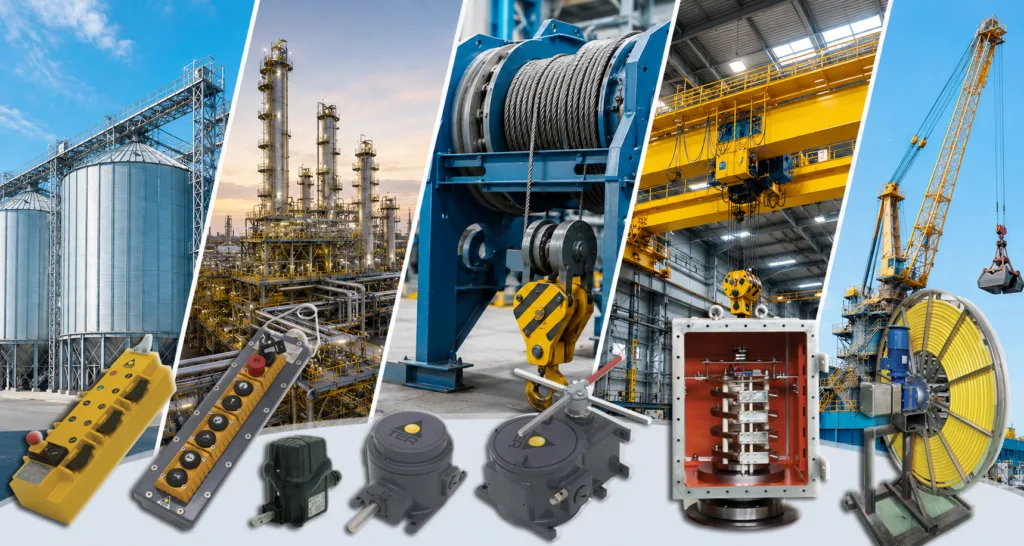
Architecture and engineering of TER ATEX limit switches
ATEX limit switches (whether configured as rotary limit switches, position limit switches or cross limit switches for overhead cranes) differ from conventional models in the structural robustness of their enclosures. Their design philosophy is based on the principle of ignition isolation or ignition containment.
The use of advanced materials such as cast iron, die-cast aluminium, AISI 316 stainless steel and reinforced technopolymers, treated to prevent the accumulation of surface electrostatic charges, ensures maximum mechanical strength. Inside the operating head (actuator), the coupling tolerances are designed to prevent the propagation of flames to the external atmosphere through flameproof joints.
From a functional safety perspective, the integration of snap-action contact blocks minimizes the duration of the electrical arc during switching. In addition, to comply with the requirements of the Machinery Directive, the devices incorporate normally closed (NC) contacts with positive opening operation.
This ensures interruption of the safety circuit even if the internal contacts become welded due to overcurrent conditions.
Explosion-Proof pendant control Stations: safety in the operator’s hands
While limit switches operate as automatic position sensing devices, pendant control stations provide the direct interface between the operator and the mechanical power of the machine. In demanding or hazardous environments, such as chemical loading and unloading terminals or control panels installed in Oil & Gas facilities, the control station enclosure must provide outstanding thermal insulation and sealing performance.
TER Explosion-Proof control stations combine an ergonomic design suitable for operation while wearing protective gloves with advanced sealing solutions. Every control element is designed according to intrinsic safety principles, preventing any interaction between electrical sparks and the flammable gases present in the operating environment.
Certifications and regulatory compliance as a competitive standard
For manufacturers exporting machinery worldwide, the regulatory compliance of every single component is a fundamental market requirement. The entire TER production process complies with internationally recognised quality standards certified by independent third-party bodies.
The design and manufacture of electromechanical and electrical equipment for the control and safety of motors, machinery and lifting systems are carried out under a UNI EN ISO 9001:2015 certified Quality Management System.
This commitment to manufacturing excellence extends to environmental management at the Calco production facilities through a UNI EN ISO 14001:2015 certified Environmental Management System, ensuring continuous control of manufacturing processes.
With regard to chemical compliance and material selection, TER products comply with the RoHS Directive 2011/65/EU and its delegated amendment 2015/863, restricting the use of hazardous substances such as mercury, cadmium and hexavalent chromium above the maximum permitted concentrations.
Furthermore, in compliance with REACH Regulation (EC) No. 1907/2006, the company continuously monitors critical components, including potentiometers and cable glands used in limit switches and pendant control stations, ensuring a lead content of less than 0.1% by weight.
Finally, attention to the product life cycle extends to environmentally responsible end-of-life management. End-of-life devices are classified as Waste Electrical and Electronic Equipment (WEEE) and must be disposed of separately from household waste, while all packaging materials are designed to be fully recyclable.
Technical section for design engineers
Guidelines for periodic ATEX maintenance inspections
To preserve the Ex characteristics of control stations and industrial limit switches over time, the technical department should establish a periodic inspection plan based on the following four steps:
- Visual Integrity Inspection: Check that the enclosure is free from cracks, deformation or dust deposits exceeding 5 mm on the external surface of the device.
- Cable Gland Tightness Inspection: Verify the mechanical integrity and correct tightening of the ATEX cable gland to prevent the ingress of external agents that could compromise the integrity of the protected enclosure.
- Electrical Continuity Test: Verify the correct operation of the positive opening NC contacts by periodically testing the emergency stop function under controlled operating conditions.
- Seal Inspection: Check the condition and elasticity of the sealing gaskets to detect any signs of thermal ageing or chemical corrosion.
Conclusion
The adoption of a TER ATEX limit switch or TER pendant control station is not simply the purchase of an electromechanical component, but a strategic decision for risk mitigation.
Italian manufacturing excellence and the availability of certified technical data provide design engineers and machine manufacturers with the confidence to operate in full compliance with applicable international regulations, protecting both the economic value of the installation and, above all, the safety of the people who operate it.