
 it
it en
en +39 039 9911011
 +39 039 9910445
 info@ter.it


In many lifting and material handling applications, the joystick is the final link between the operator’s command and the machine’s movement. When operating in harsh environments—where it is exposed to dust, vibration, accidental impacts and temperature fluctuations—its mechanical strength is not merely a specification on a datasheet, but the key factor that distinguishes a reliable system from one prone to unexpected downtime.
In this article, we explain why the robustness of an industrial joystick truly makes the difference and which key parameters should be considered when selecting the most suitable solution.
What is meant by a harsh environment?
A harsh environment is an operating environment in which equipment is exposed to stresses far more severe than those encountered in a standard industrial application. Typical examples include steel mills, foundries, cement plants, ports, construction sites and outdoor material handling installations.
In these applications, the joystick must withstand multiple stress factors simultaneously, including accidental impacts and drops, continuous vibration, dust (including conductive dust), moisture and water jets, extreme temperatures, and intensive operation that may involve thousands of actuations every day.
The conclusion is straightforward: a control device designed for a light-duty machine tool application is unlikely to withstand the demanding conditions of a steel mill for long. These environments require an industrial joystick specifically engineered for heavy-duty applications, featuring robust materials, a mechanically durable design and an appropriate degree of protection.
Mechanical strength: the parameters that really matter
The robustness of an industrial joystick is not a subjective characteristic—it is defined by measurable technical parameters. The following are the key factors to consider when selecting the right solution.
- Mechanical life: this indicates the number of operating cycles the device is designed to perform before wear affects its performance. Industrial-grade joysticks are typically rated for millions of operating cycles. The most robust solutions, such as TER’s Hercules joystick, are designed for up to 5 million operating cycles.
- Materials used for critical components: steel levers combined with structural housings made of glass fibre-reinforced nylon provide the rigidity and wear resistance required in applications subject to high mechanical stress.
- Degree of protection (IP): this defines the level of protection against the ingress of dust and liquids (e.g. IP65), making it a key specification for environments exposed to fine dust, moisture or water washdowns.
- Operating temperature range: this is the temperature range within which the joystick is guaranteed to operate correctly. TER joysticks are designed to operate in temperatures from –25°C to +70°C.
- Protection against unintended operation: the optional mechanical interlock helps prevent unintentional commands caused by accidental impacts, enhancing both operational safety and machine reliability.
Why mechanical strength affects both safety and costs
In lifting applications, a control device failure is far more than a simple inconvenience. Losing control of a suspended load is first and foremost a safety risk for operators, as well as a potential cause of unplanned downtime that, in industrial environments, can cost thousands of euros per hour.
A mechanically robust joystick significantly reduces the likelihood of failure, extends maintenance intervals and simplifies servicing. The result is higher equipment availability and lower maintenance costs throughout the product’s service life.
The same reliability-driven design philosophy applies to other lifting control interfaces, such as pendant control stations for industrial lifting applications: fewer breakdowns, a lower Total Cost of Ownership (TCO) and greater production continuity.
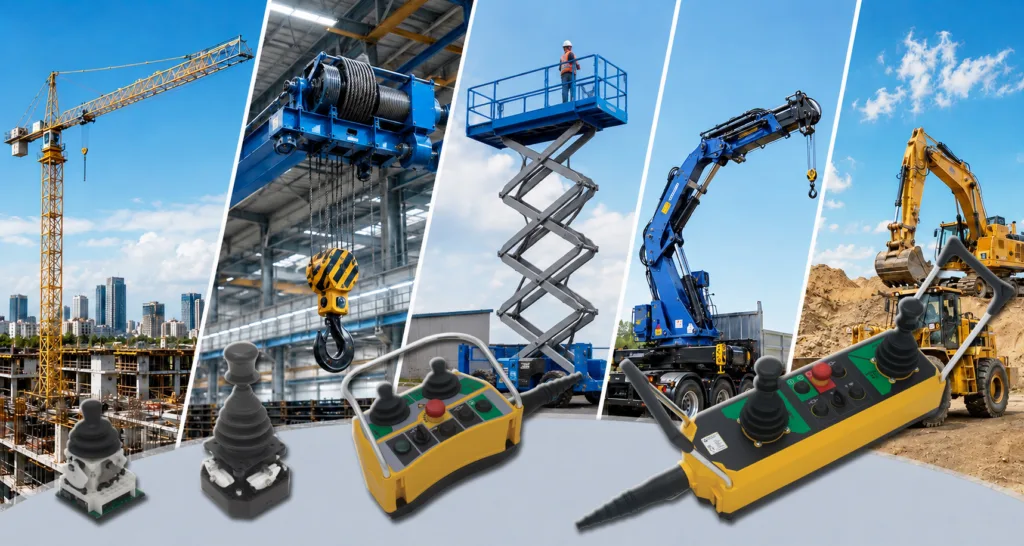
How to choose the right joystick for your application
In addition to mechanical strength, selecting the right joystick depends on the required control logic and operator ergonomics. The following checklist highlights the key factors to consider:
- Number of speed steps per direction: from a single speed up to five speed steps in each direction, depending on the level of motion control precision required.
- Operating mode: maintained or spring-return to neutral, with either cross-gate (X-Y) or 360° omnidirectional movement.
- Proportional outputs: analogue current, voltage or PWM outputs for proportional control applications.
- Grip and ergonomics: handle shape and dimensions designed for comfortable daily use, including operation while wearing industrial work gloves.
- Control station or enclosure: pairing the joystick with a dedicated enclosure determines the effective IP rating and provides the required level of impact protection.
Frequently Asked Questions
How many operating cycles should an industrial joystick be designed for?
It depends on the application and the intensity of use. For heavy-duty applications with frequent operating cycles, joysticks with a mechanical life rated for millions of operating cycles are recommended. The highest-performance solutions are designed to withstand several million operating cycles.
Can an industrial joystick be used in potentially explosive atmospheres?
Applications in potentially explosive atmospheres require devices specifically certified in accordance with ATEX and/or IECEx requirements. A standard industrial joystick is not suitable for these environments. Instead, a joystick specifically designed and certified for hazardous areas must be selected.
Conclusion
Selecting a joystick for harsh environments means evaluating its mechanical strength using objective criteria, including mechanical life, material quality, IP rating, and protection against unintended operation. These are the key factors that determine whether a system will deliver long-term reliability or be exposed to unnecessary failures and downtime.
Choosing solutions specifically engineered for heavy-duty applications, such as the TER joystick range, is the most effective way to ensure long-term operational continuity, maximum reliability and enhanced operator safety.