
 it
it en
en +39 039 9911011
 +39 039 9910445
 info@ter.it


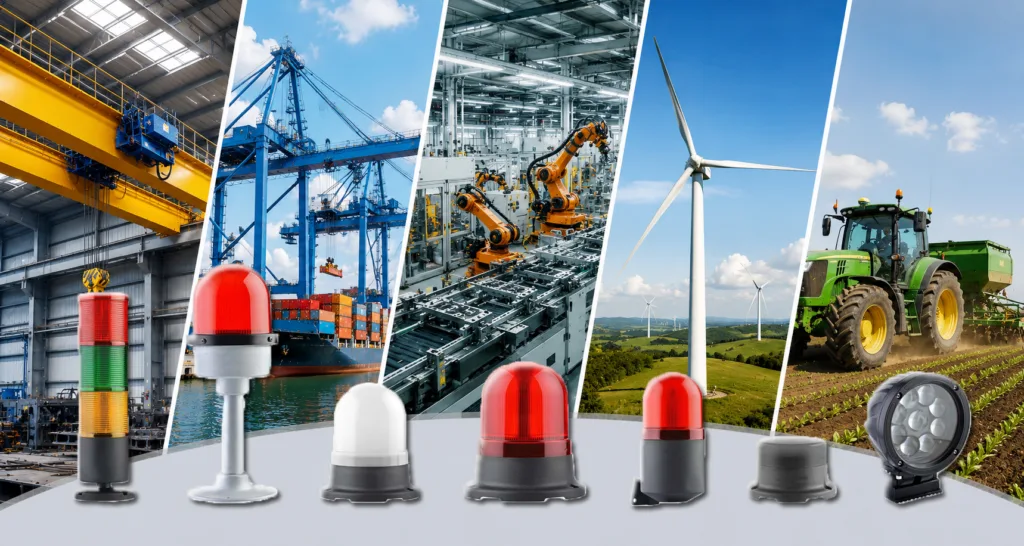
Visual and audible signalling is one of the most immediate and effective ways of communicating a machine’s operating status and warning operators of potentially hazardous situations. Stack lights, sirens, and combined audible-visual signalling devices convert operational information into light and sound that operators must be able to recognise instantly, even from a distance and in high ambient noise conditions. Their role extends far beyond improving operational efficiency: in many applications, signalling devices are an essential safety component whose design and use are governed by specific European standards.
The purpose of visual and audible signalling
In industrial machinery, signalling systems perform three primary functions: indicating the machine’s operating status (running, standby or fault condition), warning of alarms and abnormal operating conditions, and guiding operators throughout the various stages of the production process. Combining visual and audible signals significantly improves the effectiveness of the warning: the visual signal provides continuous status information that remains visible from a distance, while the audible signal immediately captures the operator’s attention, even when they are not looking directly at the machine.
Colour coding according to international standards
The choice of colours for industrial signalling devices is not arbitrary. The reference standard for the electrical equipment of machines (IEC/EN 60204-1) and the internationally recognised colour-coding standard (IEC 60073) assign a specific meaning to each colour:
- Red: fault condition or emergency (e.g. emergency stop or machine fault).
- Yellow (Amber): warning or abnormal condition requiring operator attention (e.g. excessive temperature or pressure).
- Green: normal machine or process operation.
- Blue: request for operator intervention (e.g. raw material replenishment or maintenance).
- White: user-defined condition, typically associated with process or production monitoring.
This colour coding forms the basis for the design of signalling devices such as stack lights, beacon horns, LED warning horns, and modular stack lights, which integrate multiple LED modules and an audible buzzer into a single machine-mounted unit.
Safety requirements: when signalling becomes mandatory
Beyond its informational function, signalling becomes a safety requirement whenever it is used to communicate a hazardous condition. In such cases, specific performance requirements must be met.
Visual danger signals, covered by EN 842, must be clearly distinguishable in terms of colour, luminous intensity and location. Audible danger signals, specified in ISO 7731, must be clearly audible above the ambient background noise, providing sufficient sound pressure level and a recognisable acoustic pattern. In addition, EN 981 establishes a consistent system of visual and audible signals for both hazard warnings and operational information.
In practical terms, an audible signalling device must remain clearly audible above the operating noise of the installation—often well in excess of 80 dB(A)—while a visual signalling device must remain clearly visible under the actual lighting conditions of the working environment. For this reason, the design of an effective signalling system should always begin with a careful assessment of the installation, taking into account factors such as ambient noise levels, lighting conditions, viewing distances, and the presence of physical obstructions.
The European regulatory framework: from the Machinery Directive to the new Machinery Regulation
The technical standards described above are underpinned by European legislation governing machinery safety. Until 19 January 2027, the applicable legislation remains the Machinery Directive 2006/42/EC. From 20 January 2027, it will be replaced by the Machinery Regulation (EU) 2023/1230, which will be directly applicable in all EU Member States without the need for national transposition. While preserving most of the Directive’s Essential Health and Safety Requirements (EHSRs), the new Regulation introduces important updates covering digitalisation, cybersecurity, and emerging technologies.
For machine manufacturers, this means that signalling systems, as part of the machine’s safety-related equipment, must be assessed within the framework of the CE conformity assessment and the machine’s risk assessment. Manufacturers developing machinery intended to be placed on the EU market after 20 January 2027 should already be aligning their technical documentation and component selection with the requirements of the new Regulation.
Signalling in hazardous environments
Where potentially explosive atmospheres or particularly harsh operating conditions are present, signalling devices must be certified for the intended environment. In these applications, the same protection principles that apply to ATEX-certified equipment are required: components must be specifically designed and certified so that they cannot become an ignition source while continuing to provide reliable visual and audible signalling under the most demanding operating conditions.
Designing an effective signalling system
When designing a signalling system, manufacturers should follow a number of key principles:
- Assess the operating environment, including ambient noise levels, lighting conditions, viewing distances and visibility angles.
- Apply the prescribed colour coding in accordance with IEC/EN 60204-1 and IEC 60073, avoiding non-standard colour assignments.
- Specify audible signalling devices with sufficient sound pressure levels to remain clearly audible above the ambient background noise.
- Combine visual and audible signalling for critical alarms to maximise operator awareness through multiple sensory channels.
- Verify compliance as part of the machine’s CE conformity assessment and risk assessment process.
Frequently Asked Questions
What do the colours of stack lights mean?
According to the internationally recognised colour coding defined by the relevant standards, red indicates a fault or emergency condition, yellow (amber) signals a warning or abnormal condition requiring attention, green indicates normal machine operation, blue requests operator intervention, and white is reserved for user-defined conditions.
How loud should an audible signalling device be?
There is no single prescribed sound level. According to ISO 7731, an audible danger signal must be clearly distinguishable above the ambient background noise. In many industrial environments, this requires sound pressure levels well above 80 dB(A), although the appropriate level should always be determined through a site-specific risk assessment.
Is the Machinery Directive 2006/42/EC still in force?
Yes. The Machinery Directive 2006/42/EC remains applicable until 19 January 2027. From 20 January 2027, it will be replaced by the Machinery Regulation (EU) 2023/1230, which will apply directly across all EU Member States.
Are both visual and audible signals always required?
Not necessarily. However, for critical alarms, combining visual and audible signalling significantly improves safety by ensuring that warnings are perceived even when operators are not looking directly at the machine or when background noise reduces the effectiveness of a single signalling method.
Conclusion
Visual and audible signalling is not simply an optional feature but an integral part of machine safety design. Correctly applying the prescribed colour coding, ensuring that both visual and audible signals remain clearly perceptible, and complying with the European regulatory framework—from the Machinery Directive 2006/42/EC to the Machinery Regulation (EU) 2023/1230—are fundamental requirements for designing safe and compliant machinery. Selecting signalling devices that are fully compliant with the applicable standards and appropriate for the intended operating environment is the first step towards protecting operators while ensuring reliable and uninterrupted production.